Freelancer Spotlight: Kenneth Ramclam on Engineering Growth, Building Smarter Advertising Systems, and the Future of AI




Quick Links
Quick Links
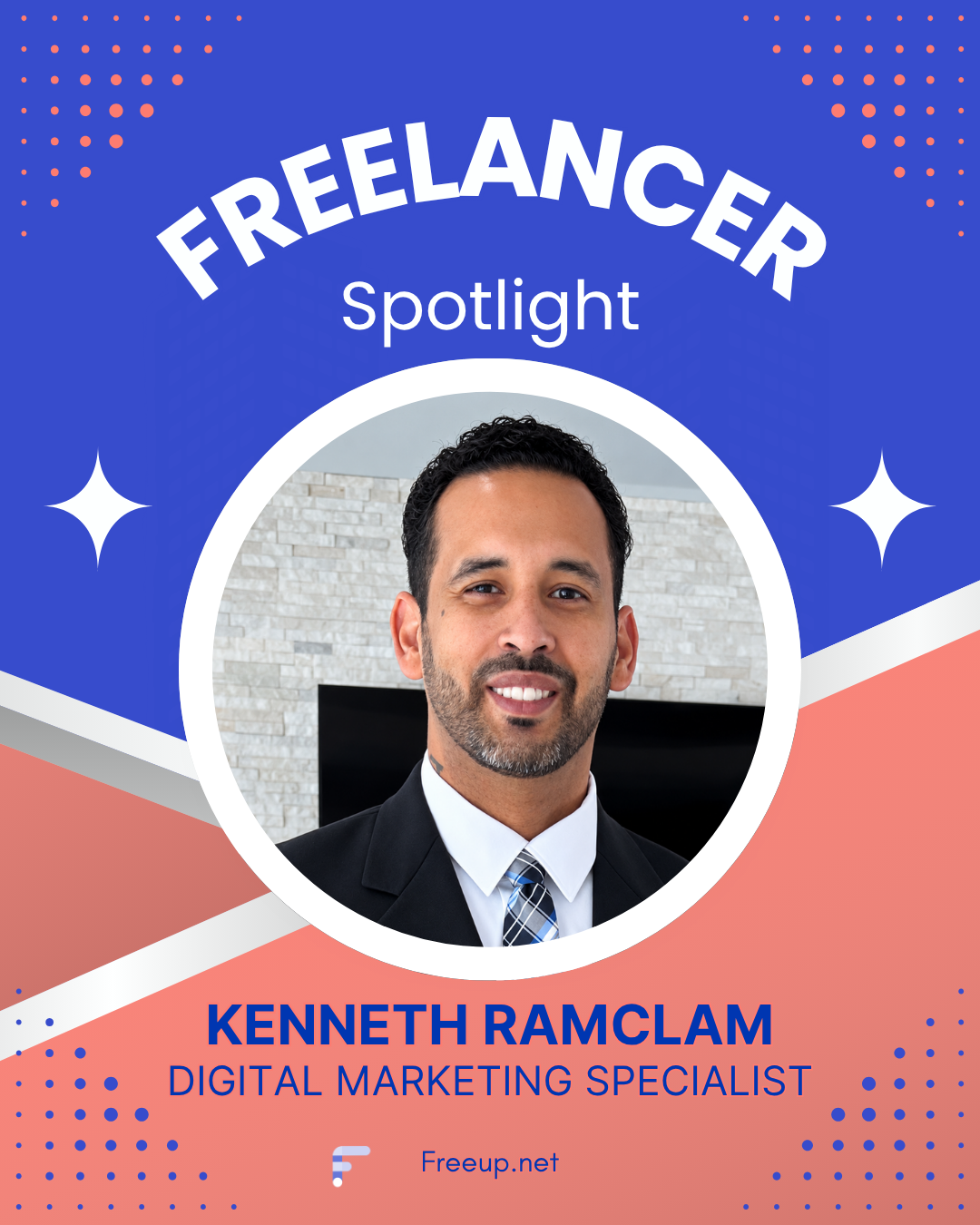
From helping transform his family’s brick-and-mortar business into a multimillion-dollar e-commerce operation to building sophisticated advertising strategies for clients, FreeUp freelancer Kenneth Ramclam brings an engineer’s perspective to digital marketing.
For Kenneth Ramclam, digital marketing has never been just about clicks, keywords, or advertising budgets. It’s about understanding how businesses work, identifying the relationships between their moving parts, and building systems that create sustainable growth.
As the founder of Malcmar, Kenneth specializes in Google Ads, Amazon PPC, and e-commerce advertising. Based in Port Charlotte, Florida, he’s been freelancing since 2018, combining his background in computer engineering with advanced analytics, AI-assisted insights, and strategic campaign management.
But his journey into digital marketing didn’t begin with an advertising campaign.
It began with a decision to leave a successful corporate career and take on a challenge that was much closer to home.
Before entering digital marketing, Kenneth worked as a Solutions Developer at Deloitte, where he developed architectural solutions for complex challenges within Michigan’s government systems.
He had established himself professionally, but the demands of his career were leaving little room for family. At the same time, he wanted to build something that could create lasting financial opportunities beyond his corporate position.
He made the decision to return to Port Charlotte and help expand his family’s brick-and-mortar business into e-commerce.
The stakes were significant. The family had millions of dollars invested in inventory, and more than 20 family members depended on the business.
Kenneth approached the challenge with the same analytical mindset he’d developed as an engineer.
Instead of simply putting products online, he focused on building the technology, advertising strategies, and operational systems needed to support long-term growth.
The results were substantial.
In the first year, the business generated roughly $50,000 in online sales. By the second year, that figure had grown to approximately $600,000.
By the fourth year, the operation was generating millions through Amazon and its website, with additional opportunities developing across retail, wholesale, and distribution. The expanded digital infrastructure also helped the business reach larger commercial buyers, including individual distribution orders exceeding $100,000.
For Kenneth, the experience changed how he thought about his career.
“What began as an opportunity to support my family’s future became the foundation of my career in digital marketing. I discovered that the most rewarding part wasn’t simply increasing sales but engineering sustainable systems that could continuously create new opportunities for growth.”
In 2020, he founded Malcmar to bring that same approach to other businesses.
His experience also gave him something that can’t be learned from advertising dashboards alone: an understanding of what business performance means when real investments and people’s livelihoods are at stake.
With a master’s degree in computer engineering, Kenneth naturally approaches advertising through data, modeling, and systematic decision-making.
But he believes one of the biggest mistakes businesses make is evaluating advertising performance without considering the environment in which those results occur.
Consumer behavior changes. Competition increases. Seasonal demand fluctuates. Marketplaces evolve.
All of these factors can influence advertising performance, sometimes dramatically.
“I wish every business owner understood that digital advertising doesn’t operate in a vacuum. Performance is directly influenced by the marketplace ecosystem, including consumer search patterns, seasonal demand, competition, and shifts in purchasing behavior.”
He points to metrics like Advertising Cost of Sales (ACOS) and Return on Ad Spend (ROAS) as examples.
They’re important measurements, but they don’t always tell the complete story.
A sudden shift in performance might indicate a problem with a campaign. It might also reflect changing customer demand, new competitive pressures, or an emerging opportunity.
Understanding the difference requires more than monitoring numbers.
“The real value of data comes from understanding the environment that produces it.”
That philosophy guides how Kenneth builds and manages advertising strategies. His goal isn’t simply to react to daily fluctuations. It’s to interpret the signals behind them and make decisions that support the business over time.
Kenneth has also seen how easily business owners can become consumed by the daily mechanics of advertising.
Managing bids, reviewing keywords, monitoring campaign performance, and adjusting budgets can take hours, especially when owners are already responsible for operations, customers, inventory, and business development.
The challenge is that spending more time inside an advertising account doesn’t necessarily produce better results.
Without the right analytical framework, even diligent campaign management can become an exercise in reacting to data rather than making strategic decisions.
Kenneth believes this is an area where specialized freelance expertise can make a meaningful difference.
“Business owners should be focused on developing their products, strengthening customer relationships, and identifying opportunities to expand their operations. Advertising is important enough to deserve specialized attention, but it shouldn’t require owners to sacrifice the time and energy needed to grow the rest of their business.”
For him, effective advertising management means creating systems that support better decisions while allowing business owners to focus on the larger responsibilities of running and growing their companies.
One of Kenneth’s most valuable lessons came from understanding that increasing sales and building a sustainable business aren’t necessarily the same thing.
He has worked with businesses that successfully moved beyond the startup stage, only to encounter serious operational and financial challenges as monthly revenue approached $30,000 to $50,000.
At that level, inventory requirements, shipping expenses, fulfillment fees, and working capital needs can change significantly.
A company may be generating strong demand but lack the infrastructure or financial resources to fulfill it consistently.
For Amazon sellers, inventory shortages can have consequences beyond missed orders. They can also affect product visibility, organic rankings, and the momentum a business has worked to establish.
That’s why Kenneth looks beyond campaign performance when thinking about growth.
A successful advertising strategy needs to work alongside inventory planning, cash flow management, distribution capacity, and the business’s changing cost structure.
As he puts it:
“One of the most important lessons I’ve learned is that generating demand and sustaining demand are two very different challenges. A business needs to be financially and operationally prepared for both.”
It’s a perspective shaped by his own family’s experience, where growing online sales required building an entire operation capable of supporting that growth.
With his engineering background and focus on data-driven systems, Kenneth sees significant potential in artificial intelligence.
But his perspective is more nuanced than the idea that AI will simply replace advertising specialists.
He believes AI is changing the type of expertise businesses need.
Tasks that once required extensive manual effort, such as analyzing keywords, reviewing campaign reports, and identifying performance patterns, can increasingly be handled more efficiently through AI and automation.
However, faster analysis doesn’t automatically lead to better business decisions.
“The real opportunity is in how we engineer AI into the systems that manage advertising performance. AI can process enormous datasets, identify patterns, and accelerate complex analysis, but those capabilities are only as valuable as the strategic framework guiding them.”
Kenneth believes the next generation of advertising specialists will spend less time performing repetitive optimizations and more time designing systems that connect advertising performance with broader business objectives.
That requires understanding financial constraints, marketplace behavior, operational dependencies, and the consequences of different decisions.
His perspective on the future of AI is clear:
“AI isn’t replacing the need for expertise. It’s increasing the value of people who know how to apply that expertise at scale.”
Kenneth expects another major shift in how businesses manage advertising over the next few years.
Today, many companies still evaluate advertising, inventory, pricing, and financial performance separately.
A marketing team might optimize a campaign based on ROAS without fully accounting for inventory availability. A business might increase advertising spend without considering how fulfillment costs affect profitability.
Kenneth believes those disconnected processes will become increasingly outdated as AI makes it easier to analyze information across business functions.
Instead of reviewing isolated reports and making individual campaign adjustments, businesses will have more opportunities to understand how decisions in one area affect the rest of their operations.
For Kenneth, the future isn’t simply about automating more tasks.
It’s about making better decisions through connected information.
“By 2027, I think the biggest competitive disadvantage won’t be a lack of data. It will be continuing to make decisions as though all that data exists independently.”
When asked to identify his freelance superpower, Kenneth doesn’t point to a particular advertising platform or technical tool.
His answer is systems architecture.
Through his training in object-oriented design, modeling languages, and engineering methodologies, he’s developed an ability to break complex business problems into interconnected components.
Where someone else might see individual campaigns, scattered datasets, or unrelated performance issues, Kenneth looks for the underlying relationships.
He wants to understand how each component affects the others and how the entire system can be designed to work more effectively.
“What comes naturally to me is taking something complicated, identifying its fundamental structure, and engineering a system that makes it more efficient, measurable, and adaptable.”
That approach applies across his work, from advertising data and financial models to AI-driven workflows.
It’s also what makes his work personally rewarding.
“I don’t just want to solve an immediate problem. I want to understand how the entire system works and build something that continues improving long after the initial challenge has been addressed.”
Kenneth’s story illustrates how a technical background, an entrepreneurial mindset, and firsthand business experience can come together to create a distinctive approach to freelancing.
His career began with engineering complex systems, but his work helping his family’s business grow showed him what those skills could accomplish in the real world.
Today, through Malcmar, he brings that perspective to businesses looking to make smarter advertising decisions and build more scalable operations.
For Kenneth, the goal has never been simply to generate more clicks or improve a single metric.
It’s to help businesses understand the systems behind their performance and build something capable of growing with them.
Looking for specialized digital marketing support?
FreeUp connects businesses with pre-vetted freelancers across digital marketing, e-commerce, advertising, and more.
No minimums. Fast access to top US and international talent.
Start Hiring